The Real Estate Map Strategy That Outranks Big National Portals
If you are a real estate agent, investor, or attorney, you already know the frustration of searching for your own high-intent keywords – like “homes for sale in Miami” or “real estate attorney near me” – only to find the first page of Google dominated by billion-dollar corporations. Zillow, Redfin, and Realtor.com have spent decades and millions of dollars building massive domain authority. Competing with them in the traditional organic search results is like trying to move a mountain with a shovel.
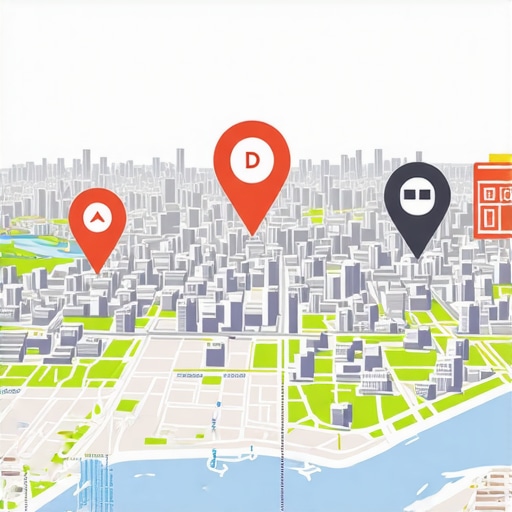
However, there is a massive crack in their armor. While these national portals own the “browsers” (those just starting their search), local professionals can own the “buyers” through google business profile seo. The Google Map Pack (the Local 3-Pack) is the one area where a local agent can consistently outrank a national giant. Why? Because Google’s local algorithm prioritizes proximity and local relevance over sheer domain size. Research from Portland Peak SEO indicates that the Local 3-Pack captures a staggering 46% of all local real estate clicks. If you aren’t in those top three spots, you are effectively invisible to nearly half of your potential local market.
The David vs. Goliath of Real Estate Search
The battle for real estate search visibility is often framed as a David vs. Goliath scenario. The “Goliaths” are the national portals that aggregate data. They have millions of pages, but they lack one thing that Google craves for local queries: a physical, verified presence within the neighborhood. This is where your google business profile seo strategy becomes your slingshot.
When a user searches for a local service, Google understands the intent is local. It triggers the Map Pack because it wants to provide the most convenient, physically accessible solution. Zillow doesn’t have an office on the corner of your street; you do. By leveraging your physical “Entity,” you can bypass the organic rankings entirely and appear at the very top of the search engine results page (SERP).
Why Portals Lose the Proximity War
To understand how to beat the big guys, you must understand that Google Maps and Google Search use fundamentally different algorithms. While traditional SEO focuses on backlinks and content volume (Prominence), the Maps algorithm is a three-legged stool consisting of Relevance, Prominence, and Proximity.
National portals rely almost entirely on Prominence. They have the most links, so they rank high organically. However, they fail the Proximity test. Google’s “Proximity Filter” is a powerful mechanism that limits the visibility of a business based on its physical distance from the searcher. In fact, you may have noticed that why your business map pin stops working the moment you cross the street is a common phenomenon in dense urban areas. This is the Proximity Filter in action.
Because portals are digital entities, they cannot compete for the “near me” or neighborhood-specific proximity signals that a verified Google Business Profile provides. By focusing on local SEO fix: speed up your map rankings in 2025, you are playing a game the portals aren’t even invited to. They are built for broad organic search; they are not built for hyper-local, proximity-based ranking.
The Anatomy of a High-Converting Real Estate Profile
To rank google business profile effectively, you cannot simply “set it and forget it.” You need a surgical approach to google business profile optimization. Here is the blueprint for a profile that doesn’t just exist, but dominates.
1. Strategic Category Selection
Most agents default to “Real Estate Agency.” While accurate, you must look at your competitors. If the top three spots are all “Real Estate Agency,” you might find an edge by using a secondary category like “Real Estate Consultant” or “Commercial Real Estate Agency” if that fits your niche. Google uses these categories to define your “Entity” in its Knowledge Graph.
2. The Power of Service Areas
If you are a residential agent, you likely cover multiple zip codes. Setting your service areas correctly is vital. However, do not overextend. If you claim to serve a 100-mile radius but your physical office is in a small suburb, Google will view your profile as less “relevant” to the outer edges. Focus on the core neighborhoods where you actually do business. For help auditing these settings, many experts use a google maps ranking service to identify where their visibility drops off.
3. Geo-Tagged Visual Evidence
Google’s AI can “read” images. When you upload photos of a recent closing in a specific neighborhood, Google extracts the metadata (EXIF data) and realizes you are active in that specific location. This builds your local authority. Don’t just post headshots; post photos of local landmarks, neighborhood signage, and properties you’ve sold. This is a key part of GMB improvement fast: unlock top rankings efficiently.
4. The NAP Consistency Myth vs. Reality
While Name, Address, and Phone number (NAP) consistency is still important, it has evolved. In 2026, Google is more concerned with “Entity Clarity.” This means your information across the web (Zillow, LinkedIn, Facebook, your website) should point to the same physical entity. If your office moved and you haven’t updated your Zillow profile, you are sending conflicting signals to Google, which can suppress your Map Pack ranking.
Hyper-Local Content & Entity Stacking
To truly rank higher on google maps, you must move beyond the profile itself and look at “Entity Stacking.” This is the process of surrounding your Google Business Profile with a web of hyper-local signals that prove you are the local authority.
Entity Stacking involves linking your GBP to:
- Local Citations: Listings on local chamber of commerce sites or neighborhood directories.
- Hyper-local Blog Posts: Instead of writing “How to buy a house,” write “The 5 best coffee shops in [Neighborhood] for remote workers.” This links your brand to the neighborhood entity.
- Google Map Embeds: Embed a customized Google Map on your website that highlights your local office and the neighborhoods you serve.
By implementing these 4 maps seo techniques to escape the 2026 proximity shadow, you are telling Google that you aren’t just a real estate agent; you are a fixture of the community. This “Local Authority” is something a national portal can never replicate. They provide generic data; you provide local context. This is the primary way to outrank Redfin’s generic data sets.
The 2026 Review Strategy: Beyond the Five Stars
We all know reviews are important, but in 2026, the *content* of the review is more important than the star rating. Google’s Natural Language Processing (NLP) capabilities now allow it to scan reviews for keywords and intent. A review that says “Great service!” is far less valuable than one that says “William was the best real estate agent in Coral Gables; he helped us navigate a complex closing near the University of Miami.”
When you ask for reviews, guide your clients. Ask them to mention the specific neighborhood, the type of property, and the specific service provided. These “keyword-rich” reviews act as mini-citations that boost your relevance for those specific terms. Furthermore, your replies to these reviews should be equally strategic. Don’t just say “Thanks!” Use your reply to reinforce the local signals. “It was a pleasure helping you find your new home in the [Neighborhood] area!”
Be warned: AI-driven filters are becoming increasingly sophisticated. Generic, bot-like reviews or a sudden influx of 50 reviews in one day will trigger a manual audit or profile suspension. Success in 3 simple adjustments for the fastest way to rank higher on google maps often comes down to the quality and consistency of your local feedback loop.
Advanced Tactics: Bypassing the Radius Lock
One of the biggest challenges for real estate professionals is the “Radius Lock” – the tendency for your map pin to only rank within a 3-5 mile radius of your office. To expand your “Green Zone” (the area where you rank #1-#3), you need to employ advanced tactics.
First, utilize a gmb ranking service or a google maps rank tracker to visualize your current reach. Once you see where your rankings drop off, you can target those specific areas with “Geo-Siloed” content on your website. Create a dedicated page for that specific neighborhood, include a Google Map embed of that area, and link it directly to your Google Business Profile. This creates a bridge of relevance from your office to the target neighborhood.
Secondly, consider your Service Area Business (SAB) settings. While having a physical office is the strongest signal, you can define the areas you serve to help Google understand your operational footprint. When combined with 7 tactics to outrank corporate maps chains in 2026, these adjustments allow you to compete in high-value neighborhoods even if your office is a few miles away.
The Role of Automation and Tools
Maintaining a top-tier Map Pack ranking is a full-time job. Between posting updates, responding to reviews, and monitoring your proximity reach, it can become overwhelming. This is where google business profile optimization tools come into play. Using professional software allows you to automate the tedious parts of Local SEO, such as scheduling posts and tracking your rank across a grid of coordinates, rather than just from one static location.
In the modern real estate landscape, you are no longer just a salesperson; you are a digital marketer. Leveraging a google maps ranking service can provide the technical edge needed to maintain visibility as Google’s algorithm continues to favor hyper-local, high-intent results over broad organic pages.
Conclusion: Reclaiming Your Local Market
The Google Map Pack is the only level playing field left in real estate search. While Zillow and Redfin may have the budget to dominate the organic listings, they cannot replicate the proximity, verified physical presence, and local authority that you possess as a neighborhood expert. By focusing on google business profile seo, optimizing your “Entity,” and gathering high-intent, keyword-rich reviews, you can capture the 46% of local clicks that the big portals are missing.
Stop trying to out-blog Zillow on a national level. Instead, start out-mapping them on a local level. The Map Pack is where the most motivated leads are looking – make sure you are the first thing they see.
If you’re ready to take your local visibility to the next level, it’s time for a professional google business profile audit. My name is William Baker, and I specialize in helping real estate professionals like you dominate the Map Pack. Let’s build a strategy that puts your name where it belongs: at the top.