Why Your Local SEO Reporting is Missing the Leads Right in Front of You
I’ve spent over 15 years in the trenches of local search, and if there is one thing that still makes my blood boil, it’s the “Green Report.” You know the one. Your SEO agency sends over a PDF filled with green upward-pointing arrows, showing you’re ranking #1 for “Plumber near me” or “Personal Injury Lawyer.” On paper, you’re winning. But then you look at your CRM, you talk to your intake team, and you realize the phone hasn’t rung in three days.
As a Local SEO Strategist, I see this disconnect every single week. Business owners are being sold “rankings” as a final product, when in reality, a ranking is nothing more than a potential opportunity. If your google business profile seo strategy ends at getting a green dot on a map, you are leaving 70% of your potential revenue on the table. In 2026, the gap between “visibility” and “conversion” has become a canyon. If you don’t know how to bridge it, you’re just paying for a digital trophy that doesn’t pay the mortgage.
Section 1: The “Green Report” Delusion
The most dangerous lie in local marketing is that “verification equals visibility.” Many business owners believe that once they’ve received that Google postcard and their listing is live, the leads will naturally follow. This couldn’t be further from the truth. In fact, research into Why Your Phone Stopped Ringing: 3 Maps Quick Fixes for 2026 shows that a verified profile can still be completely invisible to 90% of your target market due to technical suppression and inconsistent NAP (Name, Address, Phone) data across the broader web.
We call this the “Parking Lot Effect.” Most standard local seo tools measure rankings from a single point – usually the center of your zip code or, worse, from the physical location of your office. If your report says you are #1, it often means you are #1 when the searcher is standing in your parking lot. But what happens when the searcher is three miles away? Or in the neighboring suburb?
The reality is that your “Green Report” is likely a localized snapshot that ignores the “Proximity Cage.” If your google business profile seo isn’t optimized for a wider radius, you aren’t actually ranking for the city; you’re ranking for the street. This delusion keeps business owners complacent while their competitors, who understand the nuances of local prominence, are the ones actually getting the phone calls.
Section 2: The Attribution Gap – Why You Can’t See Your Leads
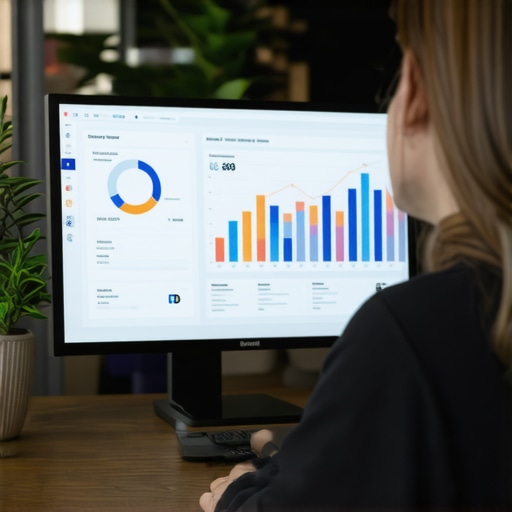
If you rely solely on the “Insights” tab inside your Google Business Profile dashboard, you are flying blind. Google’s native reporting is notoriously “fluffy.” It counts “Views” and “Searches,” but it doesn’t effectively distinguish between a customer who found you because they already knew your name (Direct) and a customer who found you because they needed a service (Discovery).
Furthermore, Google often over-counts “Views” by including every time your pin appeared on a map, even if the user never scrolled near you. Conversely, it under-counts actual intent. To truly rank google business profile listings for profit, you must implement technical attribution. This is where google business profile optimization becomes a game of data, not just keywords.
The Power of UTM Parameters
The only way to accurately track how much traffic your GBP is sending to your website is through UTM parameters. Without them, Google Analytics 4 (GA4) often buckets your GBP traffic into “Organic Search,” making it impossible to tell if a lead came from your blog or your Map Pack listing. By using a string like ?utm_source=google&utm_medium=organic&utm_campaign=gbp, you can finally see the path to conversion in your CRM or systems like HighLevel. This level of granularity is essential for identifying Using Map Analytics to Find the Exact Day Your Local Leads Died.
When you stop looking at “Views” and start looking at “Attributed Sessions,” you often find that the leads are there, but your website is failing to convert them, or the leads are “missing” because they are calling the tracking number on your profile which isn’t being synced with your main reporting. Bridging this attribution gap is the first step to moving from vanity metrics to ROI.
Section 3: Proximity vs. Prominence – The Invisible Filters
In 2026, Google’s AI filters have become incredibly aggressive. The “Proximity Trap” is a phenomenon where Google prioritizes the closest business to the searcher, even if that business has a 3.2-star rating and a half-empty profile. This is frustrating for established businesses with hundreds of 5-star reviews that find themselves filtered out because they are 4 miles away instead of 0.5 miles.
However, “Prominence” is the lever you can pull to break the proximity cage. Google defines prominence based on how well-known a business is. This is calculated through local backlinks, mentions on news sites, and – most importantly – review sentiment. If you want to expand your reach, you need local seo ranking tools that measure your “Geo-Grid” visibility, showing you exactly where your rankings drop off.
The “Radius Lock” and AI Suppression
Google’s AI now uses a “Radius Lock” to prevent one dominant business from monopolizing an entire city. If your profile lacks “hyperlocal” signals – such as content on your website specifically about local landmarks, neighborhoods, and community events – Google will keep you in your “Proximity Cage.” You might rank #1 in a 1-mile radius, but you’ll be #20 at the 3-mile mark. Understanding How to Fix the Proximity Filter That Keeps Your Profile Hidden From Local Customers requires a shift from global SEO tactics to hyper-focused local prominence building.
We’ve seen cases where a law firm ranked #1 for “Personal Injury Lawyer” but received zero calls because Google’s AI filtered their listing for “Searcher Intent.” The AI decided the searcher wanted a “Legal Aid” office instead, based on their previous search history. Your reporting needs to account for these “Invisible Filters” if you want to find the missing leads.
Section 4: The 2026 Local SEO Shift – Beyond Keywords
The Map Pack is no longer just a list of three businesses; it is an AI-driven recommendation engine. In 2026, we are seeing a massive shift toward “Zero-Click” conversions. Google is using AI to summarize your reviews and answer customer questions directly in the search results. If a customer asks, “Do they have emergency 24/7 service?” and your AI-generated summary says “Customers frequently mention long wait times,” you’ve lost the lead before they even clicked your profile.
This is why you need a google maps ranking service that looks at sentiment analysis, not just keyword density. To stay ahead, savvy marketers are using SEO Viper Tools to monitor how their brand is being perceived by Google’s LLMs (Large Language Models). It’s not just about being “found”; it’s about being “recommended.”
The Impact of “Open Now” and AI Overviews
One of the most overlooked factors in 2026 is the “Open Now” filter. A significant portion of mobile searchers now check this box by default. If your hours are not perfectly synced or if you haven’t utilized the “Secondary Hours” feature for specific services, you are becoming invisible for half of the day. Furthermore, AI Overviews (SGE) are now pulling data from your GBP posts and Q&A sections to build “Trust Scores.”
If you aren’t regularly updating your profile with high-quality images and geo-tagged posts, you are failing to provide the “Hyperlocal” signals the AI craves. For a deep dive into these shifts, check out The Critical Local SEO Trends That Will Actually Matter in 2026. The businesses winning today are those that treat their GBP as a social media platform, not a static yellow-pages listing.
Section 5: The Audit Checklist – Finding the Missing Leads
If your rankings are high but your leads are low, it’s time for a local seo audit that goes beyond the surface. You need to identify “Shadow Filters” and “Conversion Leaks” that are draining your ROI. Here is my step-by-step recovery plan to find those missing leads:
- Audit for Shadow Filters: Are you located in a building with three other businesses in the same category? Google often “filters” similar businesses in close proximity to provide variety. If your competitor has a more “complete” profile, you might be hidden.
- Secondary Service Area Analysis: Are you only ranking for your primary category? Use a google maps rank tracker to see if you are appearing for secondary services like “water heater repair” instead of just “plumber.”
- Review Sentiment Audit: Don’t just look at the star rating. Look at the “keywords” Google highlights at the top of your reviews. If those keywords don’t match your high-profit services, your google business profile seo is misaligned.
- Implement Geo-Grid Tracking: Stop using single-point trackers. Use google maps seo tools to see your rankings across a 10×10 mile grid. This will show you exactly where the “leads” are dropping off.
By making 3 Simple Adjustments for the Fastest Way to Rank Higher on Google Maps, such as optimizing your “Services” menu with long-tail descriptions and ensuring your “From the Business” section uses local entity keywords, you can often see a lead surge within 14 days.
Most gmb ranking service providers focus on the “Big Three” (Relevance, Distance, Prominence), but they forget the fourth pillar: **Engagement**. If people are seeing your profile but not clicking “Call” or “Directions,” Google will eventually demote you. Conversion optimization *is* a ranking factor.
Section 6: Conclusion – Stop Settling for Vanity Metrics
The era of “set it and forget it” local SEO is dead. If your agency is still sending you reports that only show keyword rankings, they are doing you a disservice. You need to demand transparency in attribution, proximity analysis, and sentiment tracking. Your Google Business Profile is the most powerful lead generation tool in your arsenal, but only if you stop treating it like a static directory listing.
Stop chasing green dots on a map and start chasing the revenue that comes from true local dominance. Perform a deep audit of your profile, implement UTM tracking today, and use GMB ranking tools to see the real picture of your local market. If you want to truly improve google maps ranking, you must focus on the signals that matter to both the AI and the human searcher.
It’s time to stop wondering why the phone isn’t ringing and start taking control of the leads that are currently being diverted to your competitors. Whether you do it yourself or hire a professional, ensure your strategy to rank google business profile is built on data, prominence, and a relentless focus on the customer journey. The leads are right in front of you – go get them.